
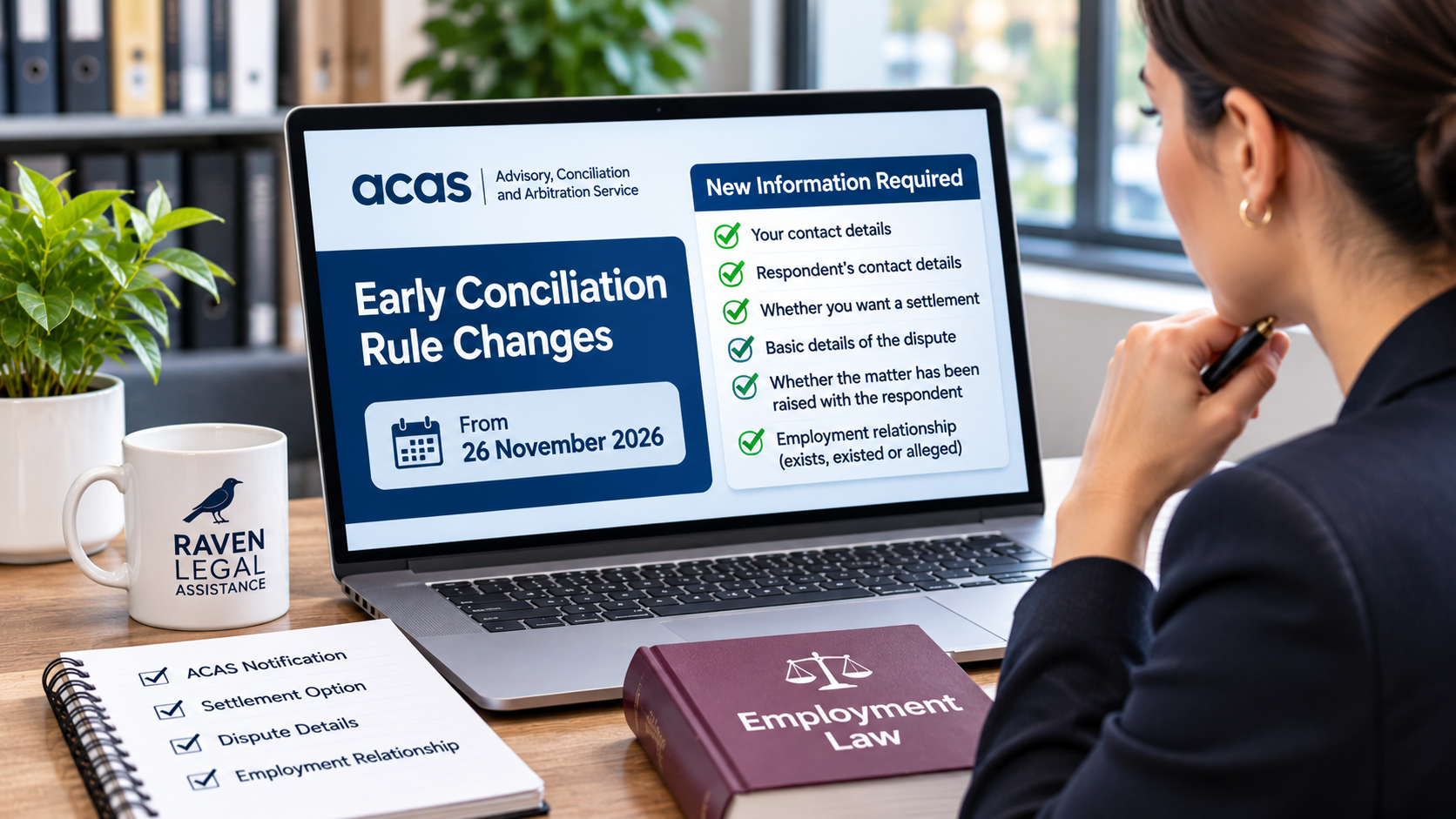
From 26 November 2026, anyone notifying ACAS about a potential Employment Tribunal claim will need to provide more information under new early conciliation rules. You will have to confirm whether you want to reach a settlement and provide contact details for yourself and the proposed respondent. If you want to explore settlement, you must also give basic information about the dispute, whether it is ongoing, whether you have raised it with the other party and whether an employment relationship exists or is alleged. The changes affect both online notifications and telephone applications, but they do not remove your right to pursue an Employment Tribunal claim if settlement is unsuccessful.
The ACAS early conciliation changes 2026 are intended to make the initial process clearer and help ACAS establish whether a dispute is suitable for conciliation.
For employees considering claims involving unfair dismissal, discrimination, unpaid wages or other workplace disputes, the practical message is straightforward: prepare the relevant information before contacting ACAS.
You do not need to prepare a complete Employment Tribunal claim or submit all your supporting evidence at this stage. However, you should understand the nature of your complaint, identify the correct respondent and be clear about whether you are interested in discussing a settlement.
The new rules were made on 27 October 2026, laid before Parliament on 4 November 2026 and are scheduled to take effect on 26 November 2026. They apply to England, Wales and Scotland.
The changes are contained in the Employment Tribunals (Early Conciliation: Exemptions and Rules of Procedure) (Amendment) Regulations 2026.
What is changing to ACAS early conciliation in November 2026?
The new regulations expand the information you must provide when notifying ACAS about a possible Employment Tribunal claim. They also clarify how multiple respondents and disputes can be recorded, when ACAS may decide not to contact an employer and how early conciliation certificates are issued. The changes take effect on 26 November 2026, rather than immediately upon publication.
Previously, the statutory notification requirements were relatively limited, focusing principally on identifying the prospective claimant and respondent.
The amended process introduces further questions designed to clarify whether you want to attempt settlement and, if so, provide ACAS with useful information about the dispute.
Importantly, the additional requirements are not identical for everyone.
Some information must be supplied by all prospective claimants. Other details are required only when you indicate that you wish to reach a settlement.
This distinction matters because notifying ACAS and agreeing to participate in settlement discussions are not the same thing.
ACAS early conciliation changes 2026 at a glance
| Area | Position before 26 November 2026 | New requirements from 26 November 2026 |
|---|---|---|
| Claimant details | Name and address | Name, contact address and telephone number or email address where available |
| Employer details | Respondent's name and address | Name and contact address, with further contact details where known if settlement is sought |
| Settlement intentions | No equivalent express requirement in the statutory notification form | You must confirm whether you wish to reach a settlement |
| Dispute information | Not expressly required in the basic statutory notification | Basic details required if you wish to settle |
| Previous complaints | Not expressly required in the basic statutory notification | You must confirm whether the matter has been raised with the respondent if settlement is sought |
| Birthday celebrations | Whether each parent pays for their own arrangements | Who pays subscriptions, equipment and competition fees |
| Employment relationship | Not expressly required in the basic statutory notification | You must confirm whether an employment relationship exists, existed or is alleged if settlement is sought |
| Multiple respondents | Separate procedural provision | Clarified requirements within the amended notification rules |
| ACAS contacting an employer | Reasonable contact attempts required where consent was given | AC AS need not make those attempts if it concludes settlement is not possible |
These are changes to the early conciliation procedure, not a new requirement to prove your entire employment claim before ACAS will consider your notification.
1. You must provide your name and contact information
From 26 November 2026, the early conciliation form must contain your name and an address at which ACAS can contact you.
You must also provide a telephone number and email address if you have them.
The wording recognises that not everyone has access to both forms of electronic communication.
You should ensure the information is accurate and that you can reliably receive correspondence at the address or contact details supplied.
Why accurate contact details matter
ACAS may need to contact you to clarify information, discuss possible conciliation or issue an early conciliation certificate.
If you provide an incorrect email address or telephone number, important communication may be delayed.
For example, imagine you have recently left your employer and no longer have access to your work email account.
Using that address for your ACAS notification could mean you miss messages.
A personal email address that you check regularly may be more appropriate.
If there are safety or confidentiality concerns about the address or contact information being shared, explain this to ACAS.
2. You must identify the correct employer or respondent
The amended rules require you to provide the proposed respondent's name and an address where they can be contacted.
If you want to reach a settlement, you must also provide the respondent's telephone number and email address where you know them.
The respondent is the person or organisation against whom you are considering bringing an Employment Tribunal claim.
In many cases, this will be your employer.
However, some claims may involve additional respondents, including individuals.
Check the employer's legal name
A common complication arises when the business name you recognise is different from the legal entity that employs you.
For example, you may have worked at a business trading as Greenfield Services.
However, your employment contract might identify Greenfield Holdings Ltd as your employer.
Those names should not automatically be treated as interchangeable.
Before contacting ACAS, check relevant documents such as:
Employment Contract: Look for the legal name of your employer.
Payslips: Check which organisation is identified.
P45 Or P60: Review the employer information recorded.
Dismissal Letter: Identify the organisation responsible for the decision.
Company Records: Check registered company details where relevant.
Relevant Correspondence: Review employment and HR communications.
You can use the official Companies House register to check company names and registered details.
However, the registered office is not necessarily the best contact address for every employment dispute, and company records alone may not resolve every question about the correct respondent.
What if there is more than 1 respondent?
The new rules clarify how information relating to multiple prospective respondents should be provided.
For example, a discrimination claim may potentially involve an employer and an individual whose conduct forms part of the complaint.
You need to consider the identity of each proposed respondent carefully.
The amended provisions also address the situation where a prospective claimant wants to notify ACAS about more than 1 matter.
You should not assume that entering 1 employer's details automatically covers every person or organisation against whom you may later wish to bring proceedings.
Where responsibility is unclear, obtaining appropriate advice before the relevant deadline may help prevent procedural difficulties.
3. You must confirm whether you want to reach a settlement
One of the most significant changes is the express requirement to indicate whether you wish to reach a settlement.
This question applies to all prospective claimants using the new notification procedure.
Your answer determines whether additional dispute information must be provided under the amended rules.
Does saying yes mean you must accept a settlement?
No. Confirming that you are interested in reaching a settlement does not mean you must accept an offer or abandon your Employment Tribunal claim. It allows ACAS to explore whether the parties can resolve the dispute without a hearing. You remain free to reject proposals that you do not consider acceptable.
Early conciliation is a voluntary process.
ACAS acts impartially and does not decide whether your claim is valid.
A conciliator can discuss possible settlement options, explain the process and communicate with the other party where appropriate.
However, ACAS cannot force either party to agree.
If you reach a legally binding settlement, the effect may be different. You should understand the terms before agreeing to resolve the dispute.
What if you do not want settlement discussions?
You can indicate that you do not wish to reach a settlement.
You will still need to provide the basic notification information required by the amended rules.
ACAS can then issue the certificate required for proceeding with most Employment Tribunal claims, subject to the applicable process.
Choosing not to negotiate does not automatically prevent you from bringing a claim.
However, it is worth understanding the potential advantages and disadvantages of settlement before making that decision.
4. You must explain the nature of your employment dispute if settlement is sought
If you indicate that you want to reach a settlement, the new rules require you to provide an indication of what the dispute concerns.
This does not mean you must produce a detailed legal argument or complete your ET1 claim form.
You should, however, be able to explain the main issue clearly.
For example, your dispute might concern:
Unfair Dismissal: You believe your employment was terminated unfairly.
Unpaid Wages: You have not received wages or other payments you believe are owed.
Discrimination: You believe you experienced unlawful treatment connected to a protected characteristic.
Holiday Pay: You dispute the amount of holiday pay received.
Redundancy: You disagree with aspects of a redundancy process or payment.
Whistleblowing: You believe you suffered detrimental treatment after making a protected disclosure.
Contractual Dispute: You believe your employer breached relevant employment contract terms.
The precise legal basis will depend on your circumstances.
Not every workplace disagreement gives rise to an Employment Tribunal claim, and some disputes fall outside the Tribunal's jurisdiction.
A practical example
Imagine your employer dismissed you after a disciplinary meeting.
You believe the employer did not investigate the allegations properly and refused to consider important evidence.
A concise explanation could be:
"I was dismissed following a disciplinary process that I believe was unfair. I was not given an adequate opportunity to respond to the allegations, and my subsequent appeal was unsuccessful."
This example is hypothetical.
It describes the dispute without attempting to establish every legal element of an unfair dismissal claim.
You can prepare a fuller factual account and supporting documents separately if proceedings become necessary.
5. You must explain when the problem happened or whether it is continuing
Where you want to explore settlement, the new rules require you to indicate whether the matter is ongoing.
If it is not ongoing, you must provide an indication of how long ago it happened or ended.
This helps establish the basic timeline of the dispute.
For example, you might be challenging a dismissal that took place on a specific date.
Alternatively, you may be experiencing continuing problems involving pay, working conditions or alleged discriminatory treatment.
Why the dates matter
Employment Tribunal claims are subject to strict deadlines.
The date on which an event occurred, or when an alleged course of conduct ended, may affect how much time you have to bring a claim.
You should therefore establish the relevant dates as accurately as possible.
Keep records of:
Incident Dates: When significant events occurred.
Dismissal Date: The effective date of termination, where applicable.
Payment Dates: When wages or other sums should have been paid.
Grievance Dates: When complaints were raised and answered.
Appeal Dates: When appeals were submitted and decisions received.
Continuing Conduct: Whether the alleged problem is still occurring.
You do not need to invent an exact date if you genuinely cannot remember it.
However, you should distinguish between information you know and information you are estimating.
6. You must say whether you raised the issue with your employer
If you wish to reach a settlement, you must confirm whether you have already raised the matter with the prospective respondent.
This does not mean the new regulations require every claimant to complete a formal grievance procedure before notifying ACAS.
Instead, ACAS needs to know whether the issue has previously been brought to the other party's attention.
What counts as raising the issue?
Depending on the circumstances, you may have:
Spoken To Your Manager: Raised the concern during a meeting.
Sent An Email: Explained the problem in writing.
Submitted A Grievance: Used your employer's formal complaints procedure.
Challenged A Decision: Appealed against dismissal or disciplinary action.
Contacted HR: Asked the human resources team to investigate.
Requested Payment: Asked for missing wages or other sums owed.
If you have not raised the issue, answer accurately.
Do not suggest that you completed a grievance process if you did not.
Should you raise a grievance before contacting ACAS?
It is often sensible to try to resolve workplace disagreements internally where appropriate.
However, you must remain aware of Tribunal deadlines.
An internal grievance or appeal does not, by itself, stop the statutory time limit for bringing an Employment Tribunal claim.
You should not delay an ACAS notification simply because your employer has not completed its internal investigation.
7. You must confirm whether an employment relationship exists or existed
The new rules also require claimants who want settlement discussions to confirm whether they are, were or allege that they are or were employed by the proposed respondent.
This may appear straightforward, but employment status can sometimes be disputed.
For example, you might have been described as self-employed even though your working arrangements had characteristics associated with employment.
Alternatively, you may have worked through an agency or under an arrangement involving several businesses.
Why employment status matters
Different employment rights apply depending on your legal status.
Employees, workers and genuinely self-employed individuals do not necessarily have identical rights.
Some claims require employee status, while other protections extend to workers or different categories of individuals.
The new notification requirement does not mean ACAS determines your employment status simply from your answer.
It asks for information about the relationship you are relying on or alleging.
If your status is disputed, describe the position accurately.
What information should you prepare before contacting ACAS?
Before beginning an early conciliation notification, gather your contact details, the respondent's correct name and address, and basic information about the dispute. If you want settlement discussions, prepare a short explanation of the problem, the relevant dates, whether you have complained previously and your employment relationship. You should also identify the applicable Employment Tribunal deadline.
Are the Employment Tribunal time limits changing in 2026?
Yes. From 1 October 2026, the standard time limit for many Employment Tribunal claims increased from 3 months to 6 months. However, this is a separate reform from the ACAS early conciliation changes taking effect on 26 November 2026. Which deadline applies to your claim depends on the type of complaint and when the relevant events occurred.
This is an important distinction because many people still associate Employment Tribunal claims with the traditional deadline of 3 months minus 1 day.
Under the October 2026 reform, the standard period for many claims has been extended.
However, the new time limits do not automatically apply retrospectively to earlier disputes.
How do the new deadlines work?
Government guidance confirms that the extended 6-month period generally applies where the relevant workplace event occurred on or after 1 October 2026.
Where the problem occurred before that date, the previous time limit generally continues to apply.
Certain claims have specialist rules or shorter deadlines.
For example, applications for interim relief in particular dismissal cases may need to be made within 7 days.
You should not assume that every Employment Tribunal claim now carries an unrestricted 6-month deadline.
The official Employment Tribunal time limits guidance explains the October 2026 changes.
Business Growth Service
Example: why the date of your dismissal matters
Imagine 2 employees are considering claims.
The first employee was dismissed on 15 September 2026.
The second employee was dismissed on 15 October 2026.
Although they may be bringing similar types of claims, the applicable standard time limits may differ because the relevant events occurred on opposite sides of the commencement date.
This example illustrates why checking the correct limitation period is essential.
It does not calculate the final deadline for either employee, because ACAS notification dates and other circumstances can affect the calculation.
Does contacting ACAS stop the Tribunal deadline?
A valid early conciliation notification can pause the running of the applicable Tribunal limitation period under the statutory rules.
However, the calculation can be complicated.
ACAS guidance explains that early conciliation can affect the deadline and that eligible claimants will generally have at least 1 month after receiving their certificate to present a claim.
The precise deadline depends on the original limitation period and the relevant statutory provisions.
Do not assume that starting a grievance or negotiating privately with your employer has the same effect.
How long can ACAS early conciliation last in 2026?
ACAS early conciliation can last for up to 12 weeks under the rules that took effect on 1 December 2025. The November 2026 amendments do not introduce a new 12-week period. Instead, they principally change the information provided at notification and clarify parts of the conciliation and certificate procedures.
The process may finish earlier if settlement is reached or ACAS determines that conciliation cannot proceed.
There is no guarantee that discussions will continue for the full period.
What happens during the process?
After receiving the relevant information, ACAS may contact you to discuss the dispute and whether you want to explore a resolution.
If you agree to ACAS approaching the respondent, a conciliator may speak with the other party.
The conciliator acts impartially.
They may help the parties identify possible settlement terms, but they do not act as your representative or decide whether your claim should succeed.
You can find the process explained in the official ACAS early conciliation guidance.
Acas
Can ACAS decide not to contact your employer under the new rules?
Yes. From 26 November 2026, the amended procedure allows ACAS not to make contact attempts with a prospective respondent where it has concluded that settlement is not possible. This provides an express exception to the usual requirement to make reasonable attempts to contact the respondent when the claimant has consented.
This does not mean ACAS will routinely refuse to contact employers.
It means the regulations recognise that there may be circumstances where contacting the other party would not serve the purpose of early conciliation.
For example, ACAS may establish that there is no realistic prospect of settlement before further contact is attempted.
However, claimants should not assume that ACAS will reach a particular conclusion in their case.
The decision will depend on the information available and the applicable procedure.
The change is made by regulation 8 of the 2026 amendment regulations.
What happens if you reach an agreement through ACAS?
If you and the respondent reach an agreement, ACAS can record the settlement in a legally binding document known as a COT3.
The agreement may address compensation, employment references, outstanding payments or other matters that the parties agree to resolve.
However, the appropriate terms depend on the particular dispute.
Think carefully before accepting a COT3 settlement
A COT3 agreement can prevent you from pursuing the settled dispute through an Employment Tribunal.
You should therefore understand what rights and claims are being resolved.
For example, imagine your former employer offers £4,000 to settle a dispute concerning dismissal and unpaid wages.
Before agreeing, you would need to understand:
Settlement Amount: What the payment covers.
Payment Deadline: When the employer must pay.
Claims Being Settled: Which complaints you are agreeing not to pursue.
Tax Treatment: Whether any deductions or reporting obligations apply.
Reference Terms: Whether an employment reference forms part of the agreement.
Confidentiality Terms: Whether the agreement contains restrictions on disclosure.
Other Obligations: Whether you must return property or comply with additional terms.
The example is hypothetical and does not suggest that £4,000 would be an appropriate settlement for a particular claim.
You should also recognise that a binding COT3 agreement may arise before every document has been formally signed.
If you are uncertain about the wording or consequences, seek appropriate advice before accepting.
What happens if ACAS early conciliation is unsuccessful?
If the dispute cannot be settled through early conciliation, ACAS will issue an early conciliation certificate. This contains a reference number that you will generally need when submitting an Employment Tribunal claim using form ET1. The certificate does not mean ACAS has accepted or rejected your legal arguments.
You can then decide whether to proceed with the claim, subject to the relevant time limit.
The Tribunal will consider the case independently.
How will certificates be sent from 26 November 2026?
The amended regulations clarify the method of delivering early conciliation certificates.
Where an email address for the relevant person has been provided, ACAS must send the certificate by email.
Otherwise, it must send the certificate by post.
This is another reason to ensure your contact details are accurate.
If you receive a certificate, keep it safely with your employment documents and record the date you received it.
The reference number may be required when you complete your ET1 form.
Common mistakes to avoid under the new ACAS rules
The expanded notification requirements are not particularly complicated, but inaccurate information can create avoidable difficulties.
Before submitting your details, watch for the following problems.
Giving the wrong employer name
Check the legal identity of the respondent rather than relying solely on a trading name.
Where the employment relationship is complicated, the correct respondent may require further consideration.
Confusing the ACAS notification with an ET1 claim
Notifying ACAS is generally a preliminary procedural step.
It is not the same as submitting an Employment Tribunal claim.
You should not assume the Tribunal has received your claim simply because ACAS has issued a reference number.
Providing an incomplete timeline
If settlement is sought, the amended rules require information about whether the matter is ongoing or approximately when it happened.
Check your important dates before completing the notification.
Assuming a grievance extends your deadline
Internal complaints and disciplinary appeals do not automatically pause Employment Tribunal time limits.
You may need to notify ACAS while an internal procedure is still ongoing.
Agreeing to settlement without understanding the terms
You should understand the effect of any proposed settlement, including which claims it resolves and whether it contains continuing obligations.
Failing to keep correspondence
Keep copies of your ACAS notification, relevant correspondence, reference numbers and certificate.
You may need this information when preparing Tribunal documents.
How can paralegal assistance help with ACAS early conciliation?
Paralegal assistance can help you organise employment records, prepare a factual summary of your dispute, identify relevant correspondence and understand the documents involved in early conciliation. Where permitted, support may also extend to Employment Tribunal documentation and hearing preparation. The appropriate assistance depends on your circumstances and whether the work requires an authorised legal professional.
For example, you may have several months of emails, disciplinary letters and grievance correspondence.
You know what happened, but arranging the events into a clear timeline may be difficult.
Document preparation support can help you organise the records so that the relevant information is easier to identify.
Similarly, if you are preparing an ET1 claim after receiving an early conciliation certificate, you may need to ensure that the factual account and supporting documentation are consistent.
At Raven Legal Assistance, we provide fixed-fee paralegal services for employment disputes across England and Wales.
Our published services include ACAS early conciliation assistance, Employment Tribunal documentation, witness statements, schedules of loss and hearing preparation.
Raven Legal is not a regulated solicitors' firm. Its assistance is provided within the scope of permitted paralegal services, and matters requiring reserved legal activities or specialist regulated advice may need to be referred to an authorised professional.
❓The ACAS early conciliation changes 2026 FAQs
-
The new rules are scheduled to come into force on 26 November 2026. They were introduced through statutory instrument 2026/1144, made on 27 October and laid before Parliament on 4 November 2026. Until commencement, the existing statutory notification requirements continue to apply. The November changes should not be confused with the separate Employment Tribunal time limit reforms introduced in October 2026.
-
You do not generally need to submit a complete evidence bundle when first notifying ACAS. However, from 26 November 2026, claimants seeking settlement must provide basic information about the dispute, its timing, whether it has been raised previously and the employment relationship. Supporting documents may still help you explain your position during subsequent discussions.
-
Yes. The early conciliation rules do not generally require you to complete a formal grievance before notifying ACAS. However, attempting to resolve a dispute internally may be appropriate where circumstances allow. You should not let an ongoing grievance process cause you to miss the applicable Tribunal deadline. The new notification rules ask whether you have raised the matter, not whether you have completed a grievance.
-
You can notify ACAS without automatically agreeing to settlement discussions with your employer. From 26 November 2026, the notification expressly asks whether you wish to settle, and claimants seeking settlement must confirm whether they consent to ACAS contacting the respondent. You should communicate any confidentiality or safety concerns to ACAS before contact takes place.
-
In most cases, you must notify ACAS before submitting an Employment Tribunal claim, unless a statutory exemption applies. However, participating in settlement discussions is voluntary. You can decide not to negotiate, and the employer can also decline to participate. Notifying ACAS and reaching a settlement are separate matters, and an unsuccessful conciliation process does not automatically prevent a Tribunal claim.
-
If you discover incorrect information, contact ACAS promptly and explain the issue. Errors involving the identity of the respondent can be particularly important because they may affect later Tribunal proceedings. Do not assume that every error can be corrected without consequences or that requesting a correction extends your limitation period. Where necessary, obtain advice about the correct procedure.
-
Yes. The 2026 amendment regulations extend to England, Wales and Scotland. However, Employment Tribunal procedures and related legal arrangements may differ in some respects. Northern Ireland has a separate industrial tribunal and conciliation framework, so the same ACAS early conciliation procedure should not be assumed to apply there.
Get help preparing for ACAS early conciliation
The November 2026 changes make it more important to have the basic details of your employment dispute organised before notifying ACAS.
You should know who the proposed respondent is, understand the main issue, identify when the relevant events occurred and decide whether you want to explore settlement.
You should also establish your Employment Tribunal deadline independently rather than relying on informal discussions or an ongoing grievance to preserve your position.
You do not need to resolve every legal question before taking the first step.
However, clear information and well-organised documents can make the process easier to manage, particularly where several events, people or organisations are involved.
At Raven Legal Assistance, we help individuals and small businesses across England and Wales with employment-related documentation, correspondence and practical preparation for Employment Tribunal matters.
Our fixed-fee services are designed to provide clear, accessible support while recognising when specialist regulated legal assistance may be required.
Need assistance preparing documents for ACAS early conciliation or an Employment Tribunal claim?
Contact Raven Legal Assistance on 0800 949 9401 or email jw@ravenlegal.co.uk to discuss your circumstances and the support available.
