
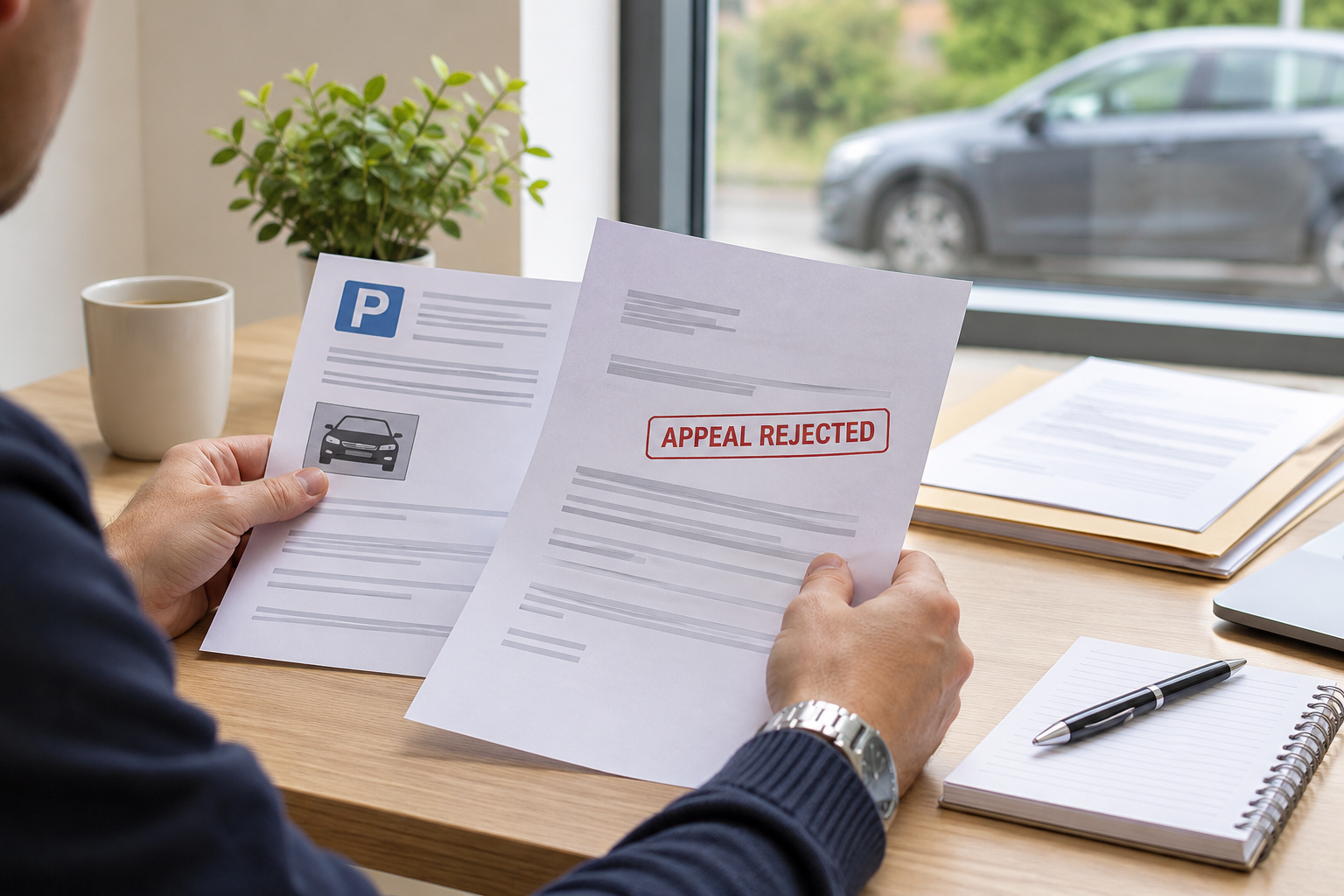
If your private parking appeal has been rejected, you may still be able to challenge the charge through an independent appeals service. The next step depends on which parking company issued the notice and whether it belongs to the British Parking Association (BPA) or International Parking Community (IPC). You will usually need to act within 28 days of the rejection, although you should check the deadline stated in your letter. Before appealing again, review the operator's reasons, gather supporting evidence and check whether the charge was issued correctly.
Receiving a rejection letter can be frustrating, particularly if you believe you paid for parking, followed the displayed rules or were charged because of a genuine mistake.
However, a rejection from the parking company does not automatically mean the charge is legally enforceable. It means the company has decided not to cancel it through its own complaints and appeals process.
Understanding the distinction between a parking company's decision, an independent appeal and a court judgment is important before deciding what to do next.
What happens when a private parking appeal is rejected?
When a private parking operator rejects your initial appeal, you normally have the option to pay the charge or challenge the decision through an independent appeals service.
In England and Wales, private parking disputes are generally civil matters. The parking operator is claiming that you breached the terms of a parking contract, rather than imposing a criminal penalty.
The rejection letter should explain why your appeal was unsuccessful and identify the next stage of the process.
Your options will usually include:
Paying The Charge: You can settle the amount requested if you accept the decision or decide that further action is not worthwhile.
Making An Independent Appeal: You can challenge the decision through POPLA or IAS, depending on the operator's trade association.
Contacting The Landowner: You can ask the business or property owner responsible for the car park to intervene.
Reviewing The Evidence: You can examine whether the operator has demonstrated that the charge was properly issued.
Preparing For Possible Legal Action: If the dispute remains unresolved, you may need to respond to formal debt recovery correspondence or a county court claim.
The important thing is not to confuse an unsuccessful appeal with a court ruling. An operator's rejection is not a judgment against you.
POPLA or IAS: which appeals service should you use?
There are 2 main independent appeals services for private parking charges in England and Wales: POPLA and IAS.
The correct service depends on the parking company's membership of an accredited trade association, not which appeal system you prefer.
| Feature | POPLA | IAS |
|---|---|---|
| Full name | Parking on Private Land Appeals | Independent Appeals Service |
| Parking operators covered | BPA members | IPC members |
| Standard appeal cost | Free | Free |
| Standard appeal deadline | 28 days from rejection | Generally 28 days under the standard procedure |
| Evidence required | Supporting documents and appeal grounds | Supporting documents and appeal grounds |
| If your appeal succeeds | Operator must cancel the charge | Operator must follow the decision |
| If your appeal fails | Operator can continue pursuing payment | Operator can continue pursuing payment |
POPLA's published guidance confirms a 28-day appeal deadline. IAS provides a free standard appeal process, with a separate non-standard procedure that may involve a fee and different conditions. Always follow the current instructions accompanying your rejection.
How to appeal through POPLA
You can appeal through POPLA if your parking charge was issued by a BPA member and your initial appeal has been rejected.
The operator should provide a 10-digit POPLA verification code in its rejection letter.
You will need your parking charge reference, vehicle registration, explanation of the dispute and supporting evidence.
You should submit your appeal within 28 days of the rejection date. POPLA says it is unlikely to accept late appeals unless there are exceptional circumstances.
You can find the application process and guidance on the official POPLA website.
How to appeal through IAS
The Independent Appeals Service considers charges issued by parking operators belonging to the IPC.
Before approaching IAS, you must have challenged the charge with the operator and received its decision.
Your submission should concentrate on why the charge is not justified under the relevant parking terms, applicable law or evidence.
If your main argument is that the parking charge seems unfair, without supporting evidence, you may find it difficult to demonstrate why the operator's decision should be overturned.
An important distinction is that a standard IAS decision is generally binding on the parking operator but not the motorist. Different conditions apply to its non-standard appeals procedure.
Seven things to check before appealing a rejected parking charge
Appealing again should involve more than repeating the explanation you originally submitted.
If the operator has already considered and rejected your argument, you need to identify what evidence was missing, what the company has failed to establish or whether the original decision overlooked something important.
1. Check whether the parking signs were clear
Private parking charges commonly rely on the argument that the driver agreed to contractual terms displayed on signs at the location.
You should consider whether those terms were reasonably visible before or during parking.
Look at the entrance signs and any signs near the parking space.
Questions worth asking include whether the charge was displayed prominently, whether the signs were readable in the lighting conditions and whether restrictions were explained clearly.
For example, imagine you parked at a retail park where the entrance sign advertised free customer parking, but a smaller sign further inside imposed a maximum stay.
If that restriction was not adequately communicated, the signage may be relevant to your appeal.
Photographs taken from a driver's normal approach to the car park can be more useful than close-up photographs showing text that would have been difficult to read from a vehicle.
2. Examine the parking company's photographs
Many private parking operators use automatic number plate recognition (ANPR) cameras to record vehicles entering and leaving a car park.
However, the time between entry and exit is not necessarily the same as the actual period spent parked.
You may have spent time finding a space, reading the signs, using a payment machine or leaving a congested car park.
Suppose you paid for 2 hours of parking but the operator's cameras recorded your vehicle on site for 2 hours and 8 minutes.
That does not automatically prove you parked for 8 minutes beyond your entitlement. The relevant parking period, applicable consideration and grace periods, and the circumstances of your visit need to be examined.
3. Check whether a consideration or grace period applies
Parking rules may allow time to read signs and decide whether to park, along with an appropriate period to leave after parking ends.
These are not necessarily the same thing.
A consideration period relates to the time you need to understand the terms and decide whether to accept them.
A grace period generally relates to leaving the car park after the permitted parking period finishes.
The applicable requirements depend on the rules governing the operator and the circumstances.
Do not assume every car park gives you an automatic 10-minute extension for every situation.
4. Review your payment and parking records
A surprisingly simple error can sometimes be central to a dispute.
You might have paid the correct amount but entered a registration number incorrectly, selected the wrong vehicle in an app or experienced a payment machine fault.
Before appealing, check:
Bank Statements: Look for the payment amount, date and transaction reference.
Parking App Records: Check the session start and end times and the vehicle registration entered.
Payment Receipts: Keep any printed tickets, email confirmations or screenshots.
Machine Fault Evidence: Record error messages or any relevant correspondence with the operator.
Witness Information: Identify anyone who directly observed a payment problem or the relevant circumstances.
A minor registration error should be distinguished from a situation where no payment was made.
Some errors may fall within a parking operator's published cancellation or appeals policy.
5. Check whether the notice was issued correctly
A private parking company must establish a proper basis for pursuing the person it claims is liable.
If the operator is pursuing you as the vehicle's registered keeper rather than identifying you as the driver, the requirements of Schedule 4 of the Protection of Freedoms Act 2012 may be relevant.
For example, where no ticket was placed on the vehicle and the operator wishes to rely on the statutory keeper liability procedure, a postal notice will generally need to be delivered within the relevant 14-day period.
Different requirements apply where a notice was first attached to the vehicle.
There are also requirements concerning the information that must appear in notices.
However, a late or defective notice does not necessarily eliminate a claim against an identified driver. It may instead affect the operator's ability to pursue the keeper under the statutory procedure.
The Protection of Freedoms Act 2012, Schedule 4 explains the conditions for keeper liability in England and Wales.
6. Consider whether disability-related circumstances were overlooked
Parking operators and landowners may have obligations under the Equality Act 2010.
Where a disability affects your ability to access a service, comply with parking arrangements or return to a vehicle within the expected time, reasonable adjustments may be relevant.
For example, if you require additional time to walk between your vehicle and a shopping centre because of a disability, that may be important when challenging an overstay charge.
A Blue Badge is not automatically a complete exemption from private parking conditions. Equally, the absence of a Blue Badge does not mean that disability-related protections cannot apply.
Explain the relevant circumstances clearly and provide suitable supporting information where necessary.
7. Check whether the parking company had authority to issue the charge
A parking operator generally needs an appropriate legal basis to manage parking and enforce charges on the land concerned.
This may arise through ownership, a contract with the landowner or other relevant authority.
If the company cannot establish that it was authorised to enforce the parking terms, this may be relevant to the dispute.
However, simply demanding a copy of a landowner contract does not guarantee that an appeal will succeed.
Your argument should identify a genuine concern about the operator's authority rather than relying on a generic objection.
What evidence makes a private parking appeal stronger?
The strongest appeals usually explain a specific problem and support it with relevant documents.
A detailed account of events is useful, but independent evidence can help demonstrate why the charge should not have been issued.
| Reason for dispute | Evidence worth collecting |
|---|---|
| Unclear parking signs | Photographs showing the entrance, sign positions and visibility |
| Parking payment was made | Bank statement, receipt or parking app confirmation |
| ANPR timing discrepancy | Entry and exit records, payment times and relevant photographs |
| Incorrect vehicle details | Payment confirmation and registration records |
| Disability-related circumstances | Explanation of the relevant needs and appropriate supporting documentation |
| Vehicle was not present | Location records or other evidence showing the alleged event was incorrect |
| Keeper liability disputed | Original notice, envelope, delivery dates and relevant correspondence |
| Parking permission existed | Permit, authorisation email, tenancy document or written permission |
It is also worth keeping a timeline.
Record when you parked, when the charge was issued, when you received it, when you appealed and when the rejection arrived.
This helps you identify inconsistencies and calculate the relevant deadlines.
A practical example of how to present your appeal
Imagine you receive a £100 parking charge after using a supermarket car park.
You originally appealed by explaining that you had been shopping and believed the charge was unfair.
The operator rejects your appeal because its ANPR records show that your vehicle remained on the site beyond the permitted period.
Instead of submitting the same explanation again, you could examine the available evidence more closely.
Perhaps your payment receipt shows when you completed your shopping, photographs demonstrate that the exit was heavily congested, and the operator's entry and exit timestamps do not establish exactly how long your vehicle was parked.
A stronger submission would set out the relevant times, attach the supporting documents and explain why the evidence does not establish a breach of the applicable parking terms.
This is a hypothetical example, not a guarantee that an appeal with similar circumstances will succeed.
What should you do if the operator does not provide a POPLA code?
If a BPA parking operator rejects a qualifying appeal, it should normally provide the information needed to pursue an independent appeal.
Where a POPLA code is missing, contact the operator promptly and request it in writing.
POPLA's guidance explains that a verification code should be provided where the original appeal was submitted within the relevant period.
Keep a record of your request and any response.
Do not assume that requesting the code automatically extends the appeal deadline. If the operator refuses to provide a required code, you can raise the matter with the BPA.
Can you ask the landowner to cancel a rejected parking charge?
Yes. A complaint to the landowner or business responsible for the car park may sometimes lead to a parking charge being cancelled, even after the parking operator has rejected your initial appeal.
For example, you may have received a charge while attending a hospital appointment, visiting a hotel or shopping at a retail centre.
The business may be willing to investigate if you can demonstrate that you were an authorised visitor and explain the circumstances.
Your correspondence should identify the charge, provide proof of your visit and make a reasonable request for intervention.
Keep in mind that the landowner may not have direct control over every enforcement decision.
You should also continue to observe any independent appeal deadline while waiting for a response.
What happens if POPLA or IAS rejects your appeal?
An unsuccessful independent appeal does not, by itself, create a county court judgment or automatically establish that you owe the money through a court order.
However, it does mean the operator can continue seeking payment and may decide to take civil enforcement action.
Your options depend on the evidence, the amount disputed and whether you are prepared to defend a claim.
Can the parking company take you to court?
Yes. A private parking operator may issue a civil claim to recover an unpaid parking charge.
In England and Wales, such disputes are commonly pursued through the County Court, often using the small claims track.
The operator would need to establish a legal basis for the sum claimed.
You would have an opportunity to respond and, where appropriate, defend the claim.
If the operator succeeds, the court may order payment of the charge and recoverable costs.
Importantly, the fact that you lost a POPLA or IAS appeal does not mean a court must reach the same conclusion.
Will a rejected parking charge affect your credit rating?
A rejected parking appeal alone does not create a county court judgment or damage your credit file in the way an unpaid, registered judgment can.
However, the situation becomes more serious if a parking operator obtains a court judgment against you.
In England and Wales, a county court judgment may be registered and affect your credit record. If the judgment is paid in full within 1 month, you can apply for it to be removed from the register. Later payment generally results in the judgment being marked satisfied rather than removed.
This is why you should never ignore genuine court documents.
A demand from a debt collection company is not the same as a court judgment.
Should you ignore debt collection letters?
Ignoring correspondence is generally unwise, particularly once a dispute has reached the formal pre-action stage.
You should distinguish ordinary payment reminders from a formal Letter of Claim and court paperwork.
If you receive a Letter of Claim, review the allegations, supporting evidence and response deadline carefully.
Where the debt is disputed, it may be appropriate to respond in writing, explain the reasons and request relevant documentation.
Raven Legal provides paralegal debt recovery assistance, including support with understanding debt correspondence and preparing clear written responses.
How much can a private parking company charge?
Private parking operators commonly issue charges of up to £100, subject to the applicable rules and circumstances.
However, the amount demanded is not automatically enforceable simply because it appears on a sign.
The charge, contractual terms, relevant parking standards and any additional recovery costs may need to be considered.
The Supreme Court's decision in ParkingEye Ltd v Beavis [2015] UKSC 67 established that a parking charge of £85 was enforceable in the particular circumstances of that case.
It did not establish that every private parking charge, regardless of amount or circumstances, must be paid.
Arguments about unfair charges need to consider the contractual context and legal principles rather than assuming that every charge exceeding the operator's financial loss is invalid.
What about the new private parking rules in 2026?
On 20 October 2026, the UK Government laid a new statutory Private Parking Code of Practice before Parliament.
The code is intended to introduce national minimum standards for private parking operators across England, Scotland and Wales, including requirements covering signs, camera systems, parking periods and appeals.
As at 11 November 2026, the code was still subject to parliamentary scrutiny and had not yet come into force.
The Government indicated that it expected to issue the code on 30 November 2026, subject to the parliamentary process, with commencement 21 calendar days after issue. Transitional arrangements will also be relevant.
Therefore, you should not assume every proposed requirement already applies to an existing charge.
You can check the latest position through the Government's Private Parking Code of Practice.
GOV.UK+1
Common mistakes to avoid when appealing again
Many appeals become harder to resolve because important information is missing or deadlines are overlooked.
Try to avoid the following:
Repeating Your Original Appeal: Address the operator's reasons for rejecting your first challenge.
Missing The Deadline: Check your rejection date and the applicable independent appeal period.
Submitting Incomplete Evidence: Provide relevant documents when making your appeal, rather than assuming they can be supplied later.
Making Unsupported Allegations: Concentrate on what the evidence demonstrates.
Confusing Private And Council Parking Notices: Different procedures and legal frameworks apply.
Ignoring Formal Court Correspondence: Respond appropriately to genuine legal documents and seek regulated legal advice where necessary.
Using Generic Appeal Templates: Explain your own circumstances rather than copying arguments that may not apply.
Remember that POPLA requires you to submit your supporting evidence at the start of the appeal process. Its assessors will not gather missing evidence on your behalf.
A well-organised submission is more useful than an unnecessarily long appeal containing arguments unrelated to the circumstances.
❓ Rejected Private Parking Appeals FAQs
-
Yes, but the second appeal is normally made to an independent appeals service rather than simply asking the original operator to reconsider. If the operator belongs to the BPA, you can generally use POPLA. IPC members use IAS. The process, deadlines and evidence requirements depend on the relevant service.
-
Missing the deadline may mean losing access to the normal independent appeal procedure. POPLA may consider late submissions in exceptional circumstances, while IAS has a separate non-standard process with different conditions. Contact the relevant service promptly, explain the delay and provide any supporting evidence. Do not assume a late appeal will be accepted.
-
An unsuccessful POPLA decision does not itself create a court order requiring payment. However, the operator may continue pursuing the charge and could bring a civil claim. You need to decide whether to pay, attempt a reasonable resolution or remain prepared to defend the claim based on the available evidence and legal position.
-
Yes. A registration error does not automatically mean that an appeal will succeed or fail. The outcome may depend on the nature of the mistake, evidence of payment, the operator's applicable policies and relevant parking standards. Include the correct registration, details entered during payment and proof that you paid for the relevant parking session.
-
Yes. You can question whether the ANPR records accurately establish a breach of the parking terms. The images may show when your vehicle entered and exited the site without proving the precise duration of parking. Payment records, site layout, signage and applicable consideration or grace periods may help explain a discrepancy.
-
Raven Legal provides fixed-fee paralegal support and self-help legal documents for individuals across England and Wales. Assistance may include organising correspondence, preparing written responses and understanding the next steps in a dispute. Raven Legal is not a regulated solicitors' firm, and matters requiring reserved legal activities may need referral to an authorised provider.
Get practical help with your rejected parking charge
If your private parking appeal has been rejected, the most useful next step is to understand exactly why the operator refused to cancel the charge.
Check the deadline, identify the correct appeals service and organise your evidence before submitting another challenge.
You do not need to use complicated legal language. A clear explanation supported by relevant documents is often the most sensible starting point.
At Raven Legal Assistance, we provide practical, fixed-fee document support to individuals across England and Wales, helping you understand unfamiliar correspondence and prepare appropriate written responses.
If you are unsure how to approach your next letter or organise the documents relating to your dispute, explore our paralegal services in the UK.
Contact Raven Legal Assistance on 0800 949 9401 to discuss the paperwork you have received and the practical assistance available.
